%20or%20the%20dark%20window%20chrome.%20Any%20surface%20that%20needs%20it%20in%20another%20colour%20uses%20the%20file%20as%20a%20CSS%20mask%20and%20paints%20it%20with%20a%20token,%20rather%20than%20a%20second%20copy%20of%20the%20geometry%20in%20another%20colour.%20--%3e%3csvg%20viewBox='0%200%20512%20512'%20xmlns='http://www.w3.org/2000/svg'%20width='512'%20height='512'%3e%3cdefs%3e%3c!--%20The%20gaps%20in%20the%20rings:%20one%20column%20and%20one%20row,%20cut%20out%20of%20both.%20--%3e%3cmask%20id='mk-rings'%3e%3crect%20width='512'%20height='512'%20fill='%23fff'/%3e%3crect%20x='234'%20y='0'%20width='44'%20height='512'%20fill='%23000'/%3e%3crect%20x='0'%20y='234'%20width='512'%20height='44'%20fill='%23000'/%3e%3c/mask%3e%3c/defs%3e%3cg%20mask='url(%23mk-rings)'%20fill='none'%20stroke='%23ffffff'%20stroke-width='26'%3e%3crect%20x='96'%20y='96'%20width='320'%20height='320'%20rx='92'/%3e%3crect%20x='152'%20y='152'%20width='208'%20height='208'%20rx='62'/%3e%3c/g%3e%3ccircle%20cx='256'%20cy='256'%20r='70'%20fill='%23ffffff'/%3e%3c/svg%3e)
Schema explorer
MongoDB does not declare a schema, so the only way to know what is in a collection is to look. The schema explorer looks, and then tells you exactly how much it looked at.
Open it from a collection's context menu.
What it shows
For every field path:
- the types it takes,
- how often it is present at all,
- a summary of its values — a range for numbers and dates, the most common values for low-cardinality strings, a length distribution for arrays.
Clicking a field inserts its path into the editor at the cursor. One Ctrl+Z
undoes the insertion, and the dialog stays open, because reading a schema means
picking more than one field.
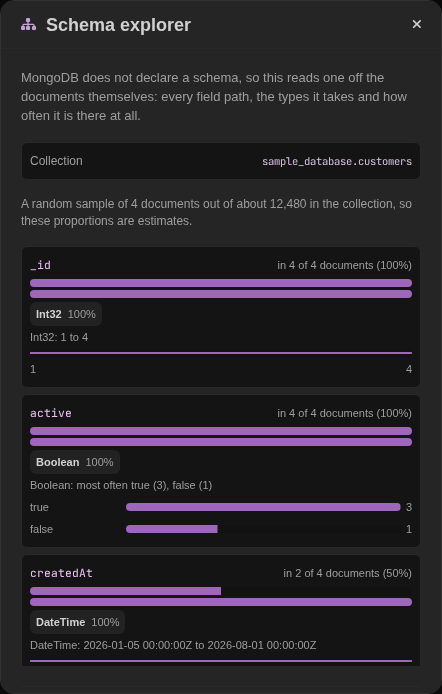
It is a sample, and the page says which
An inferred schema is not a declared one
These numbers describe the documents that were read, not the collection. The
sentence above the table always names the sample size, how it was drawn
($sample or the first N documents), and whether the whole collection was
read. "97% of a 1,000-document sample" and "97% of the collection" are two
different statements, and people act on them differently.
Two runs over the same collection can therefore give different numbers, and that is not a defect. If you need certainty about a field, the answer is a validation rule or a query, not a bigger sample.
"The whole collection" is proof, not arithmetic. It is set when the read asked for one document more than the sample size and got fewer — that is what exhausting a collection looks like. Comparing the sample against an estimated document count is not proof: that count comes from collection metadata and can be stale, so deriving "this is everything" from it would turn an estimate into a claim. When the total does come from metadata, the panel writes about.
Reading the percentages
The denominator of a nested field is its parent, not the sample. A field always present inside an optional subdocument is not a mostly-absent field.
For a path inside an array, the denominator is the documents that had the array, not the array elements. The panel says so — otherwise "2 of 3" reads as elements.
When the walk is cut short
Past a depth limit or a path-count limit the results are marked as truncated. An incomplete list that does not say it is incomplete is the same lie as an estimate presented as a fact.
Cancelling is not an empty schema. An interrupted read shows a message and a retry button, never "no fields" — that would be a claim about the collection that nothing supports.
What it is for
- Before writing a query, to find out what the fields are actually called and which of them are reliably present.
- Before proposing validation rules, which start from exactly this analysis.
- Before a reshape, to see how many documents carry the field you are about to rename.
- When a column in the grid shows mixed types and you want to know how mixed.
The charts are drawn as inline SVG by the application itself — there is no chart library and no external request involved in looking at your data.